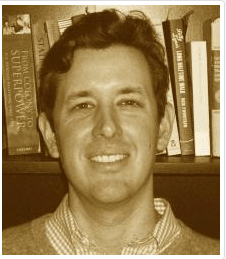
Nancy MacLean is the William H. Chafe Distinguished Professor of History and Public Policy at Duke University. A historian of the modern U.S., she is the author of several award-winning books, most recently, Democracy in Chains: The Deep History of the Radical Right’s Stealth Plan for America. A New York Times bestseller, it was a finalist for the National Book Award and the winner of the Los Angeles Times Book Award in Current Affairs and the Lillian Smith Book Award for outstanding writing about the U.S. South.
She is accompanying the documentary, BAD FAITH: Christian Nationalism’s UnHoly War on Democracy, conducting Q&A sessions afterward. In Montana alone she is visiting Missoula, Helena, Bozeman, Great Falls and Billings, in addition to screenings in other states.
Hamilton Nolan is a labor journalist, author, and organizer, who has been writing about labor issues for over 2 decades. As well as writing for In These Times, the Guardian and elsewhere, he organized the first on-line writers union In 2015, while working at the Gawker site. He has a substack blog under the tag, How Things Work.
His book, THE HAMMER: POWER, INEQUALITY, AND THE STRUGGLE FOR THE SOUL OF LABOR, was published by Hachette in February, 2024. We spoke with him on August 5, 2024 via Skype.
In this episode we share our interview with best selling author and Colorado Mesa University History Professor, Timothy Winegard. His latest book, THE HORSE: A GALLOPING HISTORY OF HUMANITY, is being published by Dutton on July 30, 2024. His five earlier books include THE MOSQUITO: A HUMAN HISTORY OF OUR DEADLIEST PREDATOR; THE FIRST WORLD OIL WAR; and FOR KING AND KANATA: CANADIAN INDIANS AND THE FIRST WORLD WAR.
We spoke with Professor Winegard about his fascinating book, THE HORSE: A GALLOPING HISTORY OF HUMANITY, on July 24, 2024, but a warning: the past two weeks since our most recent Forthright Radio had been characterized by technical breakdowns on several fronts. Without going into too many details, our Forthright Radio email address of many years became completely inaccessible on July 10th. Since July 12th, the computer had been elsewhere being worked on in the hope of retrieving the email information from it, but without success. Mere hours before our interview was scheduled,we got the computer back, but software we had been using for years, and which had been working when the computer was relinquished, no longer worked.
The reason we’re sharing this is because the audio software with which we record interviews was malfunctioning. We could hear and record Professor Winegard, but he couldn’t hear us, nor would the equipment record us. So, we had to do the interview recording him via Skype, and his listening to our questions via our ancient, failing land line phone. Bad as the audio quality of our questions is, Professor Winegard’s voice is of the quality you have come to expect. We are especially grateful to him for his patience and willingness to engage under such conditions.
The good news is that after our interview, the problems were located and remediated, so with any luck, this won’t happen again.
As for the Forthright Radio email address, that is sadly gone, never to return. However, we can still be contacted via the program’s website forthright.media contact page.
This edition of Radio Goes to the Movies features two films that are screening at the Mendocino Film Festival, THE BIG SCARY ‘S’ WORD and FIRST WE BOMBED NEW MEXICO.
In our first segment, we spoke with Yael Bridge, who produced the award winning, Left on Purpose, and Saving Capitalism, starring former Secretary of Labor Robert Reich, which was nominated for an Emmy Award in Business and Economics. She was also the director of productions at Inequality Media, making viral videos that tackle complex political issues and gained over 100 million views in 2016. She lives in Oakland, where she works as a filmmaker and film educator. Her film, THE BIG SCARY ‘S’ WORD, which she directed and produced is screening on Sunday June 2nd, at the Matheson.
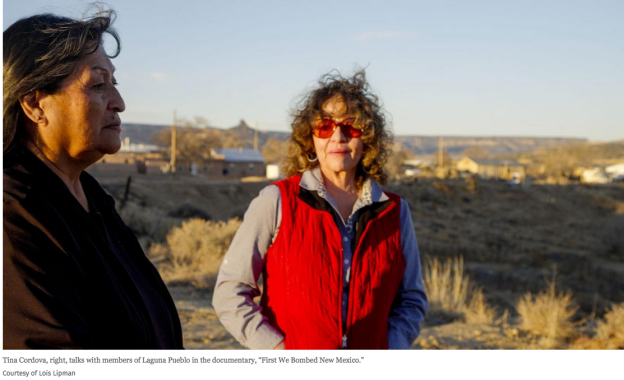
In our second segment, we spoke with Lois Lipman about her film, FIRST WE BOMBED NEW MEXICO, which tells the story that the blockbuster film, Oppenheimer, leaves out – about the nuclear victims of the first nuclear detonation in history, who lived in the villages around the Trinity test site. They were not warned, evacuated, nor informed after the explosion of any danger, much less protected from the fallout. The interview with Lois begins at 27:30.
For many years Lois Lipman researched, developed, and field produced films for 60 Minutes worldwide —from India, Gaza, Guantanamo Bay to Paris and Saint Petersburg. Her films won numerous awards including an Emmy and a Peabody. Til Death Do Us Part: Dowry Deaths in India won Best Documentary of the Year from American Women in Television and Radio, and lead to the first arrests and convictions for this crime against women in India. After Lois left 60 Minutes, she worked internationally for the BBC, Channel 4 – UK, and PBS. After teaching at the University of Maryland, Lois returned to her home in New Mexico, where she committed to making FIRST WE BOMBED NEW MEXICO, a film that exposes the injustices suffered, and continuing to be suffered, for almost 8 decades by New Mexican Downwinders. It screens on Sunday, June 2, at 10:30a.m. at The Coast Cinemas.
Special thanks to Paul Pino for permission to include his anthem, “It Ain’t Over Til We Win,” from FIRST WE BOMBED NEW MEXICO.
This edition of Forthright Radio features two university professors whose books were published this month by the University of CA Press.
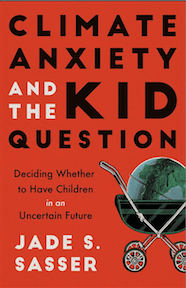
First, we hear from University of California Riverside’s Department of Gender and Sexuality Studies Professor, Jade Sasser, about her latest book, CLIMATE ANXIETY AND THE KID QUESTION: Deciding Whether to Have Children in an Uncertain Future. Her award-winning 2018 book, On Infertile Ground: Population Control and Women’s Rights in the Era of Climate Change, analyzed the shifting role of environmentalists in shaping activism and international policy advocacy focused on population, reproductive rights, and reproductive justice. In CLIMATE ANXIETY AND THE KID QUESTION, she investigates the impacts of climate change, racial injustice, and other existential threats, on reproductive decisions.
In our second half, we welcome back George Washington University’s Herbert S. Hadley Professor of Social Welfare, Mark Rank, whose book THE RANDOM FACTOR: How Chance and Luck Profoundly Shape Our Lives and the World Around Us, was published just this week. His research and teaching have focused on poverty, social welfare, economic inequality, and social policy.
We steer clear of works of fiction – not only do we want our conversations to be based in facts, but it’s a hassle to dance around spoilers. Maybe like me you vaguely know that Frances Perkins is an important person in Women’s History, mostly because she was the first female to serve in the United States Cabinet, and like me, you have a blurry visual in your mind of an unsmiling, rather severe older woman who had something to do with the New Deal and the Depression. Maybe you never wondered why Franklin Roosevelt appointed her as his Secretary of Labor, or what made her so effective in identifying social injustices and doing things to rectify them.
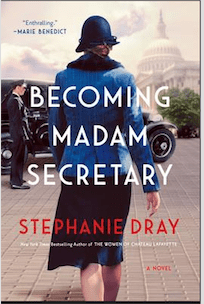
Stephanie Dray, explained what compelled her to tell Frances Perkins story – that so many of the things we take for granted today: weekends, food and fire safety regulations, unemployment insurance, social security and so much more. Her deep research has resulted in her latest book, BECOMING MADAM SECRETARY, just out from Berkley Books. Her earlier books, many of which were NYT bestsellers, include THE WOMEN OF CHATEAU LAFAYETTE, MY DEAR HAMILTON, AMERICA’S FIRST DAUGHTER, and THE NILE TRILOGY. In BECOMING MADAM SECRETARY she uncovers the forgotten history of the intellectually brilliant, politically pragmatic and physically courageous woman, who remains the longest serving cabinet member in US History, Frances Perkins.
We spoke with Stephanie Dray via Skype on the Vernal Equinox of 2024.
Long before she became part of New York or the federal governments, Frances Perkins was a “radical” activist to investigate and reform the most lethal aspects of corporate capitalism., as when she worked aas the Director of the NY Consumers’ League in 1909. Just before the signing of the Social Security Act, Frances Perkins had been informed that her husband had escaped from the mental hospital in which he had been confined. Immediately after the signing, she had to rush to New York to try to find him for his own safety.
Not only has she been honored as a national hero with this stamp, but the Episcopal Church celebrates her as a saint in their liturgy on May 13th.
As cruel wars rage across three continents and civilian casualties soar, it is easy to forget, or perhaps never to have known, that people have been analyzing the causes of war and organizing and working for peace for a very long time. These days, the term FREE TRADE is associated with right wing free marketers and multi-national corporate globalization, but this was not the story in the 19th century. Beginning in the 1840s, left-wing globalists became the leaders of the transnational peace and anti-imperialist movements of their times.
Marc-Allen Palen is an historian at the University of Exeter specializing in the intersection of British and American imperialism within the broader history of globalization since 1800. He is co-director of The History and Policy Global Economics and History Forum in London. His commentary has appeared in the Washington Post, the New York Times, NBC, the BBC, and the Conversation, among other international journals. He is the editor of the Imperial & Global Forum. His earlier book is The ‘Conspiracy’ of Free Trade: the Anglo-American Struggle over Empire and Economic Globalization, 1846-1896.
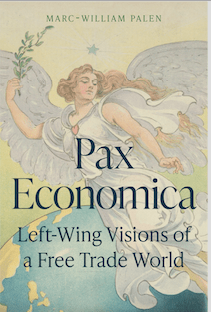
His second book, Pax Economica: Left-Wing Visions of a Free Trade World is published by Princeton University Press. In it, he explores how political economy, gender, humanitarianism, religion and ideology have shaped global imperial expansion. He documents the evolution of thinking about the impact of trade policies with social theories and the connections made not only across the Atlantic, but around the world, linking those policies with war and peace. Hard as it may be to believe these days, by the end of 19th century, an unlikely alliance of liberal radicals, socialist internationalists, feminists, and Christians envisioned free trade as essential for a prosperous and peaceful world order. And they struggled, too, with rampant nationalism, protectionism and geopolitical conflict, as well as exploitation of underdeveloped regions. The more I learned about the actual history, which Dr. Palen documents, the more dismayed I was that this history has been hidden, and the more determined I became to share it. We spoke with Marc-William Palen on February 20th via Skype.
Michael J. Graetz is professor emeritus at Columbia Law School and Yale Law School. He is a leading authority on tax politics and policy, having served in the US Treasury’s Office of Tax Policy and been an expert witness on a variety of tax matters before Congressional Committees.
He has written or co-written many books, including DEATH BY A THOUSAND CUTS: THE FIGHT OVER TAXING INHERITED WEALTH; THE WOLF AT THE DOOR: THE MENACE OF ECONOMIC INSECURITY AND HOW TO FIGHT IT; and TRUE SECURITY: RETHINKING AMERICAN SOCIAL INSURANCE.
His latest book, is THE POWER TO DESTROY: HOW THE ANTITAX MOVEMENT HIJACKED AMERICA, published by Princeton University Press. We spoke with him via Skype on February 6, 2024.
We hear much these days about how history should be taught. Although the Civil War was fought and supposedly ended 160 years ago, after the last cannon was shot and formal surrender was signed, a new war began. We are living through it still.
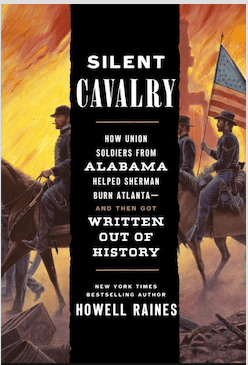
Forgive me for quoting William Faulkner once again, but he said it so well, “The past is never dead. It’s not even past.” The past may not be dead, but there were definitely efforts to bury it, and Pulitzer Prize winning journalist and author, Howell Raines, set about over six decades to un-bury some of that past, resulting in his most recent book, SILENT CAVALRY: HOW UNION SOLDIERS FROM ALABAMA HELPED SHERMAN BURN ATLANTA – AND THEN GOT WRITTEN OUT OF HISTORY, published by Crown.
Howell Raines was born in Birmingham, AL in 1943, and as you will hear, his people go way back in the hill country of northern Alabama. You can be forgiven for not knowing that they voted not to secede from the union during the Civil War, and that they were mocked with the moniker “THE FREE STATE OF WINSTON.” They had hoped to be neutral and left alone by both the Union & the Confederacy, but when the latter legislated the first military conscription in our country’s history, and ruthlessly hounded the 22 counties of northern Alabama to purloin their young men, thousands of them fled north and volunteered for the Union army, where they were formed into the bi-racial 1st Alabama Cavalry, and served with distinction. Howell Raines documents the significant role they played in restoring our union, as well as the collusion between northern and southern elites to erase their story.
Howell Raines began his journalism career, 60 years ago as a reporter for the Birmingham Post-Herald. In 1971 he became the political editor of the Atlanta Constitution. He became the NYT national correspondent based in Atlanta in 1979, becoming the Times editorial page editor in 1993 in New York City, where he was known for “the aggressive, colloquial style of his editorials.”
His books include a novel, WHISKEY MAN, set in Depression era Alabama and based roughly on his own family history; and an oral history of the civil-rights movement, MY SOUL IS RESTED: MOVEMENT DAYS IN THE DEEP SOUTH REMEMBERED. We spoke with him via Skype on January 22, 2024.
Her latest book, TRUE WEST: MYTH AND MENDING ON THE FAR SIDE OF AMERICA, was published this Fall by Torrey House Press. She received a doctorate in Environmental History from Montana State University in 2017, her dissertation focused on Mormon settlement and public land conflicts. She has studied various religious traditions over the years, with particular attention to how cultures view landscape and wildlife. The rural American west, pastoral communities of northern Mongolia, and the grasslands of East Africa have been her main areas of interest. She is the president of the Board of Directors of Wild Earth Guardians.
Although TRUE WEST focuses primarily on the intermountain west, what goes on in this region is having tremendous effect on our national politics and well-being. Just two days ago, the Colorado Supreme Court decided in favor of a suit brought by CO Republican and unaffiliated voters, working with Citizens for Responsibility and Ethics in Washington, CREW, against CO Secretary of State Jena Griswold and Donald J. Trump, taking advantage of a CO law that allows voters to challenge a candidate’s eligibility. In this case the eligibility was challenged under Section 3 of the 14th amendment, claiming that the former president had engaged insurrection , based on his actions surrounding the Jan. 6, 2021, U.S. Capitol attack by his supporters at his urging. As you will hear in this interview with Betsy Gaines Quammen, recorded in the Beyond the Deep End Studio on the Winter Solstice of 2023, extremist organizing in this region over more than a decade contributed to that insurrection. We share it with you now.