Nancy MacLean is the William H. Chafe Distinguished Professor of History and Public Policy at Duke University. A historian of the modern U.S., she is the author of several award-winning books, most recently, Democracy in Chains: The Deep History of the Radical Right’s Stealth Plan for America. A New York Times bestseller, it was a finalist for the National Book Award and the winner of the Los Angeles Times Book Award in Current Affairs and the Lillian Smith Book Award for outstanding writing about the U.S. South.
She is accompanying the documentary, BAD FAITH: Christian Nationalism’s UnHoly War on Democracy, conducting Q&A sessions afterward. In Montana alone she is visiting Missoula, Helena, Bozeman, Great Falls and Billings, in addition to screenings in other states.
In this episode we share our interview with best selling author and Colorado Mesa University History Professor, Timothy Winegard. His latest book, THE HORSE: A GALLOPING HISTORY OF HUMANITY, is being published by Dutton on July 30, 2024. His five earlier books include THE MOSQUITO: A HUMAN HISTORY OF OUR DEADLIEST PREDATOR; THE FIRST WORLD OIL WAR; and FOR KING AND KANATA: CANADIAN INDIANS AND THE FIRST WORLD WAR.
We spoke with Professor Winegard about his fascinating book, THE HORSE: A GALLOPING HISTORY OF HUMANITY, on July 24, 2024, but a warning: the past two weeks since our most recent Forthright Radio had been characterized by technical breakdowns on several fronts. Without going into too many details, our Forthright Radio email address of many years became completely inaccessible on July 10th. Since July 12th, the computer had been elsewhere being worked on in the hope of retrieving the email information from it, but without success. Mere hours before our interview was scheduled,we got the computer back, but software we had been using for years, and which had been working when the computer was relinquished, no longer worked.
The reason we’re sharing this is because the audio software with which we record interviews was malfunctioning. We could hear and record Professor Winegard, but he couldn’t hear us, nor would the equipment record us. So, we had to do the interview recording him via Skype, and his listening to our questions via our ancient, failing land line phone. Bad as the audio quality of our questions is, Professor Winegard’s voice is of the quality you have come to expect. We are especially grateful to him for his patience and willingness to engage under such conditions.
The good news is that after our interview, the problems were located and remediated, so with any luck, this won’t happen again.
As for the Forthright Radio email address, that is sadly gone, never to return. However, we can still be contacted via the program’s website forthright.media contact page.
Zoë Schlanger is an award winning environmental journalist and reporter with The Atlantic. Her book, THE LIGHT EATERS: HOW THE UNSEEN WORLD OF PLANT INTELLIGENCE OFFERS A NEW UNDERSTANDING OF LIFE ON EARTH, was published in May 2024 by Harper.
We are at a revolutionary moment in the field of botany, a veritable paradigm shift for those who pay attention to such things, and Zoë Schlanger chronicles the remapping of scientific frontiers, as one assumption after another is being proven not only to be false, but ignorant and arrogant. Along with the scientists she interviews, she explores questions such as do plants communicate with each other and even other species? Can they recognize and favor their own kin? Can they respond to visual and aural stimuli, store memories and learn? Are they conscious and intelligent? How is any of this possible lacking a brain? We asked about these and other questions when we spoke with her via Skype on June 24, 2024.
This edition of Radio Goes to the Movies features two films that are screening at the Mendocino Film Festival, THE BIG SCARY ‘S’ WORD and FIRST WE BOMBED NEW MEXICO.
In our first segment, we spoke with Yael Bridge, who produced the award winning, Left on Purpose, and Saving Capitalism, starring former Secretary of Labor Robert Reich, which was nominated for an Emmy Award in Business and Economics. She was also the director of productions at Inequality Media, making viral videos that tackle complex political issues and gained over 100 million views in 2016. She lives in Oakland, where she works as a filmmaker and film educator. Her film, THE BIG SCARY ‘S’ WORD, which she directed and produced is screening on Sunday June 2nd, at the Matheson.
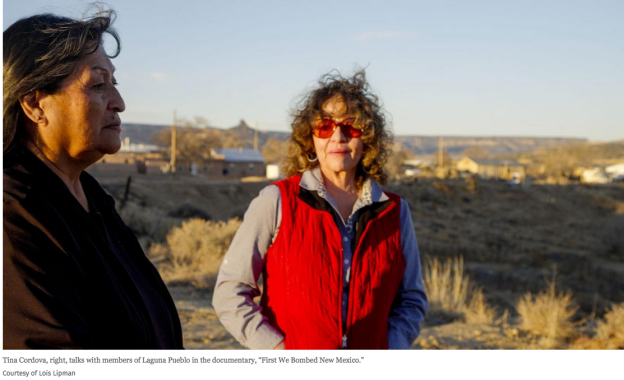
In our second segment, we spoke with Lois Lipman about her film, FIRST WE BOMBED NEW MEXICO, which tells the story that the blockbuster film, Oppenheimer, leaves out – about the nuclear victims of the first nuclear detonation in history, who lived in the villages around the Trinity test site. They were not warned, evacuated, nor informed after the explosion of any danger, much less protected from the fallout. The interview with Lois begins at 27:30.
For many years Lois Lipman researched, developed, and field produced films for 60 Minutes worldwide —from India, Gaza, Guantanamo Bay to Paris and Saint Petersburg. Her films won numerous awards including an Emmy and a Peabody. Til Death Do Us Part: Dowry Deaths in India won Best Documentary of the Year from American Women in Television and Radio, and lead to the first arrests and convictions for this crime against women in India. After Lois left 60 Minutes, she worked internationally for the BBC, Channel 4 – UK, and PBS. After teaching at the University of Maryland, Lois returned to her home in New Mexico, where she committed to making FIRST WE BOMBED NEW MEXICO, a film that exposes the injustices suffered, and continuing to be suffered, for almost 8 decades by New Mexican Downwinders. It screens on Sunday, June 2, at 10:30a.m. at The Coast Cinemas.
Special thanks to Paul Pino for permission to include his anthem, “It Ain’t Over Til We Win,” from FIRST WE BOMBED NEW MEXICO.
This edition of Forthright Radio features two university professors whose books were published this month by the University of CA Press.
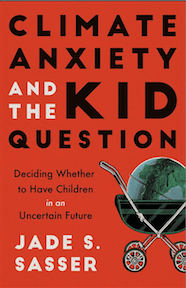
First, we hear from University of California Riverside’s Department of Gender and Sexuality Studies Professor, Jade Sasser, about her latest book, CLIMATE ANXIETY AND THE KID QUESTION: Deciding Whether to Have Children in an Uncertain Future. Her award-winning 2018 book, On Infertile Ground: Population Control and Women’s Rights in the Era of Climate Change, analyzed the shifting role of environmentalists in shaping activism and international policy advocacy focused on population, reproductive rights, and reproductive justice. In CLIMATE ANXIETY AND THE KID QUESTION, she investigates the impacts of climate change, racial injustice, and other existential threats, on reproductive decisions.
In our second half, we welcome back George Washington University’s Herbert S. Hadley Professor of Social Welfare, Mark Rank, whose book THE RANDOM FACTOR: How Chance and Luck Profoundly Shape Our Lives and the World Around Us, was published just this week. His research and teaching have focused on poverty, social welfare, economic inequality, and social policy.
On Wednesday January 17th, 2024 at the Ellen Theater, The Bozeman Film Society, in collaboration with Eagle Mount, presents an outstanding documentary, FULL CIRCLE. It explores the question, “faced with a traumatic injury that renders you permanently disabled; how would you reinvent yourself?”
It interweaves the stories of two people who not only survived devastating spinal cord injuries, but became inspirations to those who learn of their personal renewal and triumphs. In 2014, 22 year old Trevor Kennison‘s life was forever altered by a broken back. Barry Corbet, an intrepid skier, mountaineer, explorer, filmmaker, and Jackson Hole legend, broke his back in a helicopter crash in 1968. Frustrated by a pre-ADA culture that did not accept or support the disabled, Barry reinvented himself, becoming a seminal leader in the disability community. As you will hear in this interview with the film’s director, writer, and cinematographer, Josh Berman, FULL CIRCLE follows Trevor on a path towards post-traumatic growth in parallel with Barry, 50 years later. Their stories mirror each other, connected through time and space by common locations and motifs; injuries in the Colorado back country, rehab at Denver’s Craig Hospital, fame in Jackson Hole; but also, through their shared resilience and refusal to let their passion for life be limited by their injuries.
FULL CIRCLE is an unblinking examination of the challenges of Spinal Cord Injury, and a celebration of the growth that such tragedy can catalyze.
A guest panel will follow the screening including Adaptive Athletes Drew Asaro, Liz Ann Kudrna, and Beth Barclay Livington.
Her latest book, TRUE WEST: MYTH AND MENDING ON THE FAR SIDE OF AMERICA, was published this Fall by Torrey House Press. She received a doctorate in Environmental History from Montana State University in 2017, her dissertation focused on Mormon settlement and public land conflicts. She has studied various religious traditions over the years, with particular attention to how cultures view landscape and wildlife. The rural American west, pastoral communities of northern Mongolia, and the grasslands of East Africa have been her main areas of interest. She is the president of the Board of Directors of Wild Earth Guardians.
Although TRUE WEST focuses primarily on the intermountain west, what goes on in this region is having tremendous effect on our national politics and well-being. Just two days ago, the Colorado Supreme Court decided in favor of a suit brought by CO Republican and unaffiliated voters, working with Citizens for Responsibility and Ethics in Washington, CREW, against CO Secretary of State Jena Griswold and Donald J. Trump, taking advantage of a CO law that allows voters to challenge a candidate’s eligibility. In this case the eligibility was challenged under Section 3 of the 14th amendment, claiming that the former president had engaged insurrection , based on his actions surrounding the Jan. 6, 2021, U.S. Capitol attack by his supporters at his urging. As you will hear in this interview with Betsy Gaines Quammen, recorded in the Beyond the Deep End Studio on the Winter Solstice of 2023, extremist organizing in this region over more than a decade contributed to that insurrection. We share it with you now.
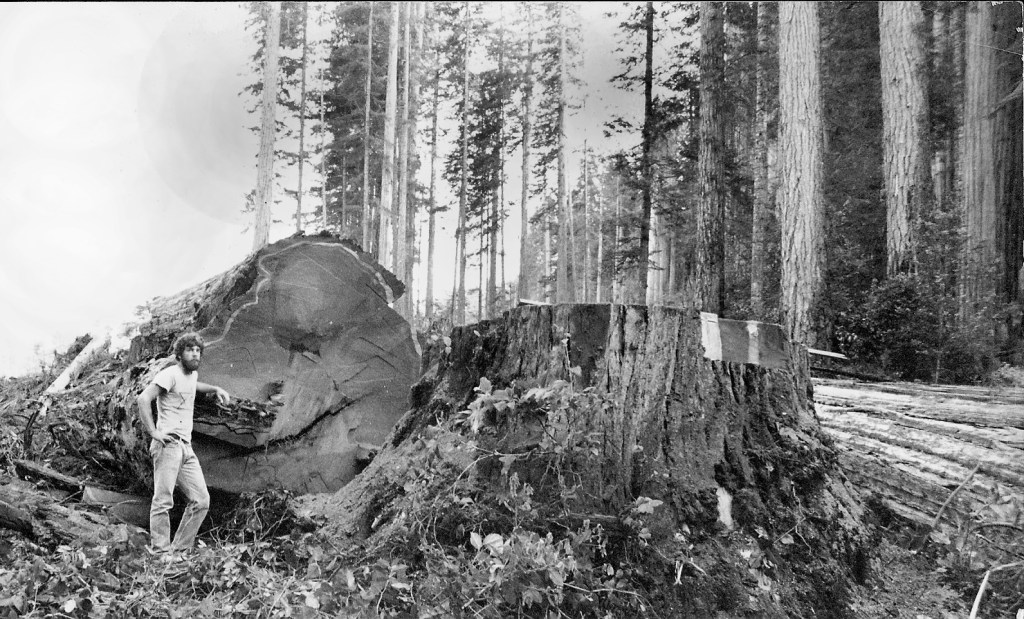
In this edition of Forthright Radio our guest is journalist, author, environmentalist, Greg King. I first became aware of Greg’s work back in the late 1980s, when we who lived in the remnants of the once great redwood biome organized to protect what remained of that ecosystem from voracious predatory capitalists, who proudly vowed to “log to infinity.”
Greg King in All Species Grove 1987 (courtesy of Greg King)
Greg is the fifth generation of his family to live in Sonoma and Mendocino Counties of northern CA, – his ancestors having arrived in the 1860s and owned what was then one of the largest redwood mills, the King-Starrett mill in Monte Rio. The The King Range Mountains were named for his great-great uncle, John King, who lived north of Westport in Mendocino County, due to his hospitality to the government surveyor before his mapping that steep coastal range in the Lost Coast. Long before Greg was born, the last of the great redwood forests in Sonoma County were cut, but there were second growth stands and massive stumps of 20’ or greater diameter which served as his childhood playground. After graduating from UC Santa Cruz in 1985, he joined the staff of the West Sonoma County Paper, now called the Bohemian, where he won his first of two Lincoln Steffens Investigative Journalism Award.
Investigating Louisiana-Pacific’s “logging to infinity” in his neighborhood led him to the Maxxam Corporation’s hostile takeover, financed by junk bonds, of Humboldt County’s Pacific Lumber Company and the ensuing accelerated destruction of the last intact, ancient redwood groves in private hands to pay off the debt. Exploring these untouched forests with the largest, oldest trees on the planet inspired a reverence and awe unlike anything he had ever experienced. The rest, as they say, is history.
In his book, THE GHOST FOREST: Racists, Radicals, and Real Estate in the California Redwoods, he describes how he left his home and promising career to devote his life to identifying and protecting those few remaining giants and the biome centered on them. He is credited with mapping the remaining groves, including The Headwaters Forest, as well as pioneering tree sitting to prevent logging of redwoods in Humboldt County.
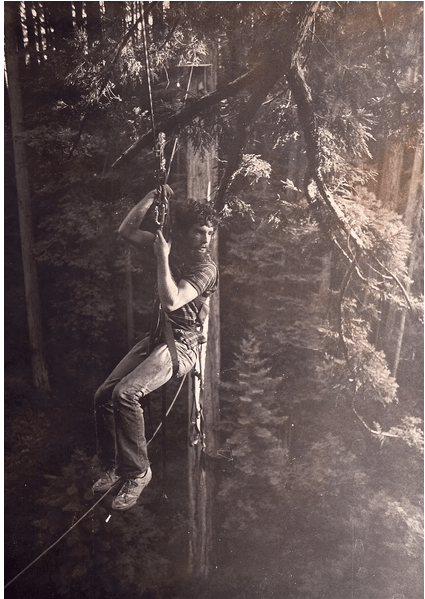
Greg King on traverse during a tree-sit in the middle of 1,000 acre All Species Grove, September 1987. Note sleeping platform on the tree in the background, tied under the lowest branch 150′ above the forest floor. (photo by Mary Beth Nearing, courtesy of Greg King)
What might have been merely a memoir became a shocking exposé of the all too successful efforts of financiers and industrialists via their creation of the Save the Redwoods League in 1917, to subvert the growing desire of the public to protect and preserve the remaining redwoods, by promoting instead small “beauty strips” along roadways to hide devastating clearcuts. As one of the first to delve into The League’s archives at U. C. Berkeley’s Bancroft Library, Greg followed the history back to the federal acts of the 19th century, that allowed well organized land fraud syndicates to place what had been 2 million acres of undisturbed ancient forests into private corporate hands. His research led him to the connections between the Save the Redwood League creators and the so-called “scientific racism” eugenics movement, which was so helpful to the Nazis in Germany, and which still plagues our nation even today. We spoke with Greg King on October 18, 2023 via Skype.
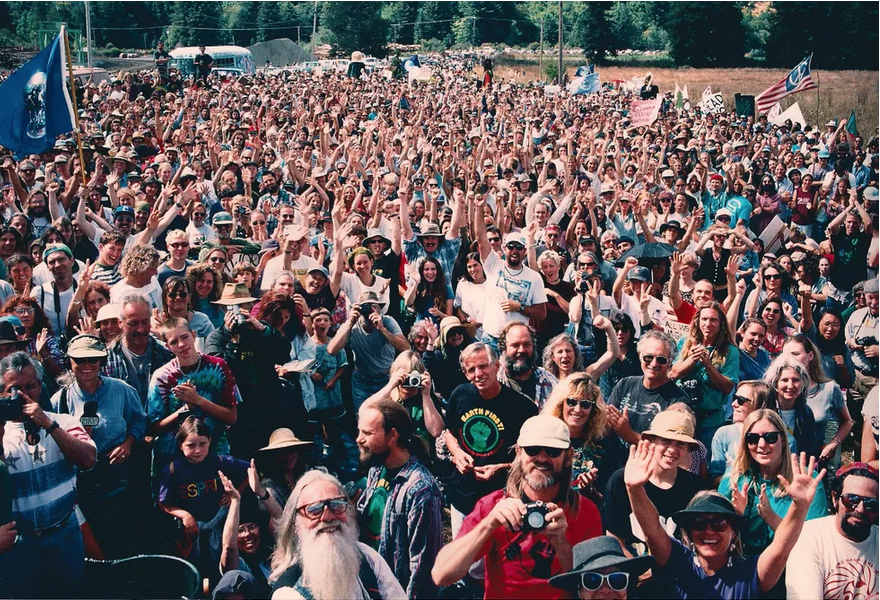
In 1996 more than 8,000 people protested ancient redwood logging at the Pacific Lumber log deck along Yager Creek, in Humboldt County. More than 1,000 were arrested. It remains the largest single-day arrest number for an environmental protest in U.S. history. photo by Greg King
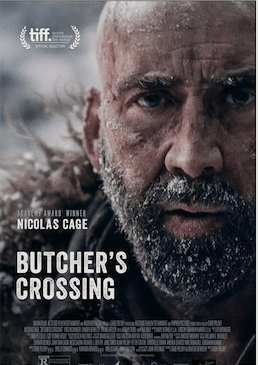
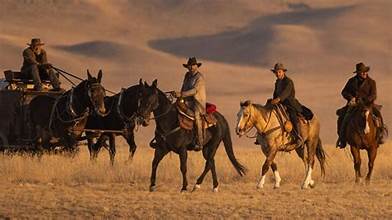
On Wed., October 25, The Bozeman Film Society will be screening Butcher’s Crossing, which was filmed in just 19 days entirely in Montana, mostly on the Blackfeet Indian Reservation. Glacier National Park and Nevada City in Madison County were also locations. We spoke with producer, Molly Conners, about Butcher’s Crossing and producing it here in Montana.
Molly Conners is founder and CEO of Phiphen, an independently owned film, television, and digital media company focused on producing creative, smart productions for a global audience. Her films have been Emmy nominated, and she has produced or executive produced 35 feature films over the last 15 years that have earned a total of 4 Academy Awards and 11 Academy Award nominations. Some of Molly’s notable credits include the 2014 Academy Award-winner BIRDMAN, the 2009 Academy Award-nominated FROZEN RIVER, as well as the films: KILLER JOE, THE IMMIGRANT, JOE, and RULES DON’T APPLY.
Her latest film, Butcher’s Creek, is based on the seminal 1960 novel of the same name by John Edward Williams, with a screenplay co-written by director, Gabe Polsky. An epic frontier adventure, Butcher’s Crossing, is a riveting commentary on human nature, ambition, masculinity, and man’s relationship to his natural environment. Academy Award winner Nicolas Cage stars in this tragedy about the last of the buffalo hunters in the Old West. Young greenhorn, Will Andrews, played by Fred Hechinger, has left his undergraduate life at Harvard to find adventure in the wild west. He teams up with Cage’s character, buffalo hunter, Miller, a taciturn frontiersman offering a hunt of an unprecedented number of buffalo for their pelts in a secluded valley in the Colorado Rockies. Their crew must survive an arduous journey, where the harsh elements will test everyone’s resolve, leaving their sanity on a knife’s edge.
We spoke with Molly Conners on October 13, 2023 via Skype.
As each month breaks historic records for the hottest ever recorded, we realize that hot though they have been, they may very well be the coolest we’ll ever experience in the future. As wild fires, smoke and floods devastate huge swathes of the globe, one asks what can be done? While many dither (or worse), young people take action. Through their courage and determination, with their adult allies, they demand their rights to a livable future in courts around the world.
On September 27, 2023 in Strasbourg, France, The hearing of 6 Portuguese youth plaintiffs in the historic lawsuit, Duarte Agostinho v. Portugal and 32 Others, took place at the European Court of Human Rights.
The plaintiffs want governments to set and meet science-based targets for cutting carbon emissions in the 33 countries: all EU member states, plus Norway, Switzerland, Russia, Turkey, and the United Kingdom.
The fact that the European Court of Human Rights elevated this case to its Grand Chamber demonstrates how seriously the Court takes allegations that the inadequate climate policies of these 33 States breach their legal obligation to prevent climate-related harm.
Among the third party interveners in Aghostino was the Center for International Environmental Law. We invited Nikki Reisch, the Director of the Climate & Energy Program, at the Center for International Environmental Law (CIEL) to be our guest on Forthright Radio. At CIEL, Nikki works at the intersection of human rights and the environment, overseeing research, analysis, legal and policy advocacy related to climate change, its causes, consequences, and responses to it.
Prior to joining CIEL, Nikki Reisch was the Legal Director of the Center for Human Rights and Global Justice, and a Supervising Attorney in the Global Justice Clinic at NYU School of Law. She was also an Adjunct Professor in the Human Rights and Gender Justice Clinic at CUNY School of Law. Her work focused on human rights and environmental harms related to a range of domestic and international issues, including open-pit mining, surveillance of human rights defenders, immigration enforcement, torture, and arbitrary detention.
Her engagement in climate justice began with her five-year tenure as the Africa Program Manager at the Bank Information Center, where she worked to curb development finance for fossil fuels and supported front-line communities challenging extractive industry projects. In her subsequent position as the Policy Advisor on Forests and Climate Change at Rainforest Foundation UK, Nikki co-founded a global coalition tracking reduced emissions from deforestation and degradation in the UNFCCC negotiations and pursued transnational advocacy with partners in the Congo Basin to mitigate the human rights risks posed by climate change and policy responses to it.
She has litigated before domestic and international courts, appeared before UN treaty bodies and the accountability mechanisms of international financial institutions, and co-authored amicus briefs in several human rights cases. She is co-editor with Philip Alston of Tax, Inequality, and Human Rights (Oxford University Press, 2019) and has published other articles and reports on human rights and environmental matters.
In our far ranging conversation, which was recorded on October 3, 2023 via Skype, she told us “Sometimes when politics break down — as they have despite decades of climate negotiations — the law can break through.”
In our conversation, Nikki referred to the European Court of Human Rights decisions as binding on the “Member States of the EU.” She actually meant The Council of Europe (46 member states, including the 27 EU states).











 Forthright Radio