Nancy MacLean is the William H. Chafe Distinguished Professor of History and Public Policy at Duke University. A historian of the modern U.S., she is the author of several award-winning books, most recently, Democracy in Chains: The Deep History of the Radical Right’s Stealth Plan for America. A New York Times bestseller, it was a finalist for the National Book Award and the winner of the Los Angeles Times Book Award in Current Affairs and the Lillian Smith Book Award for outstanding writing about the U.S. South.
She is accompanying the documentary, BAD FAITH: Christian Nationalism’s UnHoly War on Democracy, conducting Q&A sessions afterward. In Montana alone she is visiting Missoula, Helena, Bozeman, Great Falls and Billings, in addition to screenings in other states.
David Daley is the author of the national bestseller Ratf**ked: Why Your Vote Doesn’t Count, which has been credited for kick-starting the national drive to end gerrymandering; and Unrigged: How Americans Are Battling Back to Save Democracy.
He returned to discuss his assiduously researched, well written and important latest book, ANTIDEMOCRATIC: INSIDE THE FAR RIGHT’S 50 YEAR PLOT TO CONTROL AMERICAN ELECTIONS, published by Mariner Books. It follows on the themes of those earlier books, and it couldn’t be coming at a more crucial time in our nation’s history’s, as we reel towards this tumultuous 2024 election, as democracy itself seems to be on the brink.
In addition to his books, David’s journalism has appeared in the New Yorker, the Atlantic, New York Times, Washington Post, and The Guardian, and he is the former editor in chief of Salon.com, as well as a senior fellow at FairVote. He has taught journalism and political science at Wesleyan University, Boston College, Smith College and the University of Georgia. We spoke with him via Skype on September 26, 2024.
Links to some articles pertinent to this interview:
In this edition of Forthright Radio our guest is retired Federal Circuit Judge of the United States Court of Appeals for the District of Columbia Circuit, David S. Tatel. After many years as a civil rights attorney in private practice and public service, he was nominated by President Bill Clinton in June of 1994 to the seat vacated by Judge Ruth Bader Ginsburg, when she ascended to the Supreme Court. After only a one hour hearing and unanimous vote by the Senate Judiciary Committee, he was confirmed by the full Senate in a voice vote. In the 1970s, he was the founding Director of the Chicago Lawyers’ Committee for Civil Rights Under Law, and then director of the national Lawyers Committee for Civil Rights Under Law. During the Carter Administration, he served as the Director of the Office for Civil Rights in the Department of Health, Education and Welfare. By that time, he was fully blind, after the gradually progressing deterioration of his vision due to the genetic condition, retinitis pigmentosa.
His book, VISION: A MEMOIR OF BLINDNESS AND JUSTICE, was published by Little, Brown and Company in June of 2024. It’s the story of one individual’s journey in the service of justice through many historical moments – from John F. Kennedy, who inspired him to the nobility of public service, through the Donald J. Trump’s administration’s harangues against “The Deep State” and the mockery of the very idea of service, to his decision to retire from the bench during the Biden administration, so as not to repeat the strategically tragic decision of his friend, Ruth Bader Ginsberg, not to retire. As you will hear in this interview, the lack of judicial restraint by the Republican appointees of the current Supreme Court, and their ideological overturning of well established precedents in civil rights and environmental cases contributed to his decision to retire when he did from that position he loved.
But it’s not just a memoir of his legal experiences or philosophy. It’s a very human love story – for his wife of almost 60 years, his four children, and most recently, his guide dog, Vixen, as well as a memoir of his blindness, vulnerability, and rising above disability to his decades of public service.
We spoke with Judge Tatel via Skype from his home in rural Virginia on August 19, 2024.
Hamilton Nolan is a labor journalist, author, and organizer, who has been writing about labor issues for over 2 decades. As well as writing for In These Times, the Guardian and elsewhere, he organized the first on-line writers union In 2015, while working at the Gawker site. He has a substack blog under the tag, How Things Work.
His book, THE HAMMER: POWER, INEQUALITY, AND THE STRUGGLE FOR THE SOUL OF LABOR, was published by Hachette in February, 2024. We spoke with him on August 5, 2024 via Skype.
What if you attended your local small town public library board meeting to speak out against book censorship and soon found your reputation smeared by people from an entirely different county with lurid and untrue allegations that go viral, alleging that you advocate teaching anal sex to 11 year olds?
That’s what happened in July of 2022 to award winning Middle School librarian, Amanda Jones, which she writes about in her forthcoming book, THAT LIBRARIAN: THE FIGHT AGAINST BOOK BANNING IN AMERICA. Among her many awards are the 2021 School Librarian of the Year and the 2023 American Association of School Librarians’ Intellectual Freedom Award, as well as the American Library Association’s Paul Howard Award for Courage.
The group who singled her out of the thirty or so other people who spoke against book censorship at that Livingston Parish public library meeting, is Citizens for a New Louisiana, whose leader is Michael Lunsford. His confederate, Ryan Thames, operates the Facebook page, “Bayou State of Mind,” which posted mean, fallacious memes about her repeatedly, so she sued them for defamation of character.
We spoke with Amanda Jones on July 5, 2024 via Skype, but before we share our conversation, we begin with what she actually said on July 22, 2022, that made her the focus of the ire of reactionary, Christian Nationalist agitators.
This edition of Radio Goes to the Movies features two films that are screening at the Mendocino Film Festival, THE BIG SCARY ‘S’ WORD and FIRST WE BOMBED NEW MEXICO.
In our first segment, we spoke with Yael Bridge, who produced the award winning, Left on Purpose, and Saving Capitalism, starring former Secretary of Labor Robert Reich, which was nominated for an Emmy Award in Business and Economics. She was also the director of productions at Inequality Media, making viral videos that tackle complex political issues and gained over 100 million views in 2016. She lives in Oakland, where she works as a filmmaker and film educator. Her film, THE BIG SCARY ‘S’ WORD, which she directed and produced is screening on Sunday June 2nd, at the Matheson.
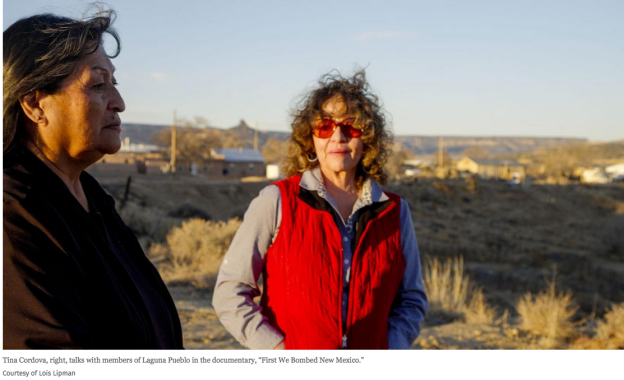
In our second segment, we spoke with Lois Lipman about her film, FIRST WE BOMBED NEW MEXICO, which tells the story that the blockbuster film, Oppenheimer, leaves out – about the nuclear victims of the first nuclear detonation in history, who lived in the villages around the Trinity test site. They were not warned, evacuated, nor informed after the explosion of any danger, much less protected from the fallout. The interview with Lois begins at 27:30.
For many years Lois Lipman researched, developed, and field produced films for 60 Minutes worldwide —from India, Gaza, Guantanamo Bay to Paris and Saint Petersburg. Her films won numerous awards including an Emmy and a Peabody. Til Death Do Us Part: Dowry Deaths in India won Best Documentary of the Year from American Women in Television and Radio, and lead to the first arrests and convictions for this crime against women in India. After Lois left 60 Minutes, she worked internationally for the BBC, Channel 4 – UK, and PBS. After teaching at the University of Maryland, Lois returned to her home in New Mexico, where she committed to making FIRST WE BOMBED NEW MEXICO, a film that exposes the injustices suffered, and continuing to be suffered, for almost 8 decades by New Mexican Downwinders. It screens on Sunday, June 2, at 10:30a.m. at The Coast Cinemas.
Special thanks to Paul Pino for permission to include his anthem, “It Ain’t Over Til We Win,” from FIRST WE BOMBED NEW MEXICO.
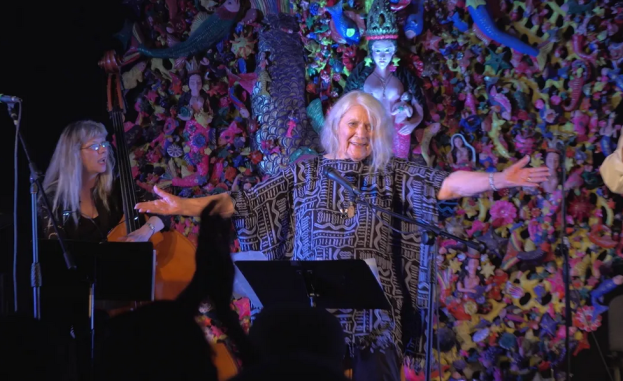
It’s the merry month of May, and that means it’s time for our “Radio Goes to the Movies” editions of Forthright Radio. For the past 16 years, we have devoted our programs in the month before the Mendocino Film Festival to featuring interviews with filmmakers whose films are screening the first week in June at the Festival. Today, we feature two interviews. Our first is with Maureen Gosling about her wonderful film, THE 9 LIVES OF BARBARA DANE.
Maureen Gosling, director and editor of THE 9 LIVES OF BARBARA DANE– the folk, blues and jazz singer, international social justice activist and recording star, wife, mother of three, feminist, record producer, unwavering maverick and general good troublemaker on the road when she was 90 years old. She is turning 97 on Sunday, May 12th! THE 9 LIVES OF BARBARA DANE is an underground history of a singer-agitator, whose unbending principles guide her through notoriety, obscurity, and finally, music legend.
In concert with son Jesse Cahn
In the second segment, an interview with Sabrine Keane and Kate Dumke, directors of the documentary, PRECONCEIVED, which investigates the question: Where does someone turn these days when facing an unplanned pregnancy? It’s an insightful look into the rise of crisis pregnancy centers proliferating across the United States, and explores the complex role of deception, finances, faith, and privacy…
Barbara Dane’s songs, which end this edition, Working People’s Blues and Resistance Hymn, are included courtesy of Smithsonian Folkways Recording, with special thanks to Will Griffin for permission to do so.
This edition of Forthright Radio features two university professors whose books were published this month by the University of CA Press.
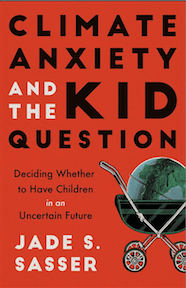
First, we hear from University of California Riverside’s Department of Gender and Sexuality Studies Professor, Jade Sasser, about her latest book, CLIMATE ANXIETY AND THE KID QUESTION: Deciding Whether to Have Children in an Uncertain Future. Her award-winning 2018 book, On Infertile Ground: Population Control and Women’s Rights in the Era of Climate Change, analyzed the shifting role of environmentalists in shaping activism and international policy advocacy focused on population, reproductive rights, and reproductive justice. In CLIMATE ANXIETY AND THE KID QUESTION, she investigates the impacts of climate change, racial injustice, and other existential threats, on reproductive decisions.
In our second half, we welcome back George Washington University’s Herbert S. Hadley Professor of Social Welfare, Mark Rank, whose book THE RANDOM FACTOR: How Chance and Luck Profoundly Shape Our Lives and the World Around Us, was published just this week. His research and teaching have focused on poverty, social welfare, economic inequality, and social policy.
Randy Fertel is a writer and philanthropist dedicated to the arts, education, New Orleans, and the environment. His philanthropy includes as the President of the Fertel Foundation supporting a number of causes, including The New Orleans Edible Schoolyard, Artist Corps New Orleans, YAYA (that’s Young Artists, Young Aspirations), and The Ridenhour Prizes, which recognize and encourage those who persevere in acts of truth-telling that protect the public interest, promote social justice or illuminate a more just vision of society.
The prizes memorialize the spirit of Ron Ridenhour, the Vietnam veteran who wrote a letter to Congress and the Pentagon in 1969 describing the horrific events at My Lai, the infamous massacre of the Vietnam War, bringing the scandal to the attention of the American public and the world. Ridenhour went on to become an investigative journalist, and his extraordinary life and career exemplified the fearless truth-telling which the eponymous prizes now recognize. The 2024 recipients are Emma Pildes and Tia Lessin for their documentary film, The Janes; Congressman Jamie Raskin received The Courage Prize; and The Truth Telling Prize went to Dawn Wooten, the nurse at the Irwin County Detention Center Immigration Facility in Georgia, who filed a whistleblower complaint in September 2020 after being demoted for raising concerns about inadequate medical care during the COVID-19 pandemic and non-consensual gynecological procedures performed on women in detention. Her claims have been verified by a Senate subcommittee, ICE records, and independent medical experts. If it were not for her disclosures, women in immigrant detention would still be at risk of undergoing unnecessary, non-consensual surgeries there. However, Ms. Wooten, a single mother of five, faces ongoing retaliation.
Additionally, The Fertel Foundation organized Dutch Dialogues. South Louisiana, like the Netherlands, must adapt to the threats inherent to living in a subsiding delta. The Dutch Dialogues workshops brought together Dutch engineers, urban designers, landscape architects, city planners and soils/hydrology experts together with their Louisiana counterparts to explore whether Dutch approaches to water management, landscape architecture, flood protection and urban design were relevant to New Orleans as it recovered from Hurricane Katrina.
But More pertinent to this edition of Forthright Radio are his Improv Conferences NOLA, inspired by his life-long fascination with improvisation. Randy Fertel’s earlier books include, A Taste for Chaos: The Art of Literary Improvisation and The Gorilla Man and the Empress of Steak: A New Orleans Family Memoir. His most recent book is WINGING IT: IMPROV’S POWER AND PERIL IN THE TIME OF TRUMP, just published by Spring Publications.
We steer clear of works of fiction – not only do we want our conversations to be based in facts, but it’s a hassle to dance around spoilers. Maybe like me you vaguely know that Frances Perkins is an important person in Women’s History, mostly because she was the first female to serve in the United States Cabinet, and like me, you have a blurry visual in your mind of an unsmiling, rather severe older woman who had something to do with the New Deal and the Depression. Maybe you never wondered why Franklin Roosevelt appointed her as his Secretary of Labor, or what made her so effective in identifying social injustices and doing things to rectify them.
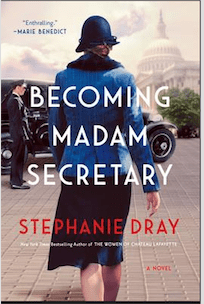
Stephanie Dray, explained what compelled her to tell Frances Perkins story – that so many of the things we take for granted today: weekends, food and fire safety regulations, unemployment insurance, social security and so much more. Her deep research has resulted in her latest book, BECOMING MADAM SECRETARY, just out from Berkley Books. Her earlier books, many of which were NYT bestsellers, include THE WOMEN OF CHATEAU LAFAYETTE, MY DEAR HAMILTON, AMERICA’S FIRST DAUGHTER, and THE NILE TRILOGY. In BECOMING MADAM SECRETARY she uncovers the forgotten history of the intellectually brilliant, politically pragmatic and physically courageous woman, who remains the longest serving cabinet member in US History, Frances Perkins.
We spoke with Stephanie Dray via Skype on the Vernal Equinox of 2024.
Long before she became part of New York or the federal governments, Frances Perkins was a “radical” activist to investigate and reform the most lethal aspects of corporate capitalism., as when she worked aas the Director of the NY Consumers’ League in 1909. Just before the signing of the Social Security Act, Frances Perkins had been informed that her husband had escaped from the mental hospital in which he had been confined. Immediately after the signing, she had to rush to New York to try to find him for his own safety.
Not only has she been honored as a national hero with this stamp, but the Episcopal Church celebrates her as a saint in their liturgy on May 13th.











 Forthright Radio