
Dr. Christine Webb is an Assistant Professor in the Department of Environmental Studies at New York University, where she is part of the Animal Studies program. Her research is driven by growing awareness that the ecological crisis demands a profound shift in how we understand other animals and our place among them.
Her work seeks to elucidate the complex dynamics of animal social life, and to apply this knowledge to foundational questions in animal ethics and conservation. She investigates how animals manage and mitigate social disruptions, the emotional and motivational states that underlie those processes, and the cultural influences shaping them, with a focus on nonhuman primates.
She also studies how prevailing societal norms, values, and institutions shape contemporary scientific knowledge of other animals. As you will hear, her work examines the pervasiveness of the belief in human exceptionalism, and how this ideology—oftentimes hidden—biases scientific exploration of the more-than-human world.
She asks: How are cutting edge scientific insights revealing striking interdependencies among different species? How has anthropocentrism fueled an essentially competitive, hierarchical view of Nature? How does this in turn obscure our understanding of evolution, and of ourselves, in ways that perpetuate notions of human exceptionalism?How has this emphasis on competition led people to misinterpret and misuse evolutionary theory to explain the current anthropogenic crisis of life on earth? And How can a less anthropocentric understanding help us re-imagine it?
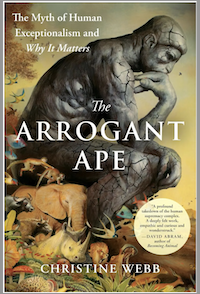
She explores these questions and more in her book, THE ARROGANT APE: THE MYTH OF HUMAN EXCEPTIONALISM AND WHY IT MATTERS, published by Avery. We spoke with Professor Webb on February 24, 2026 via Zoom as she, and many others were snowbound in New York.
Articles pertinent to this interview:
Scientists recorded a sperm whale birth up close for the first time. They discovered something extraordinary. The marine mammals act like midwives, supporting mothers and their calves through delivery. https://www.nationalgeographic.com/animals/article/sperm-whale-birth-video?utm_source=firefox-newtab-en-us
How Brainless Slime Molds Redefine Intelligence https://www.scientificamerican.com/article/brainless-slime-molds/
Baby chicks link certain sounds with shapes, just like humans do https://www.npr.org/2026/02/19/nx-s1-5717039/baby-chicks-link-certain-sounds-with-shapes-just-like-humans-do
Chimpanzees pick up communication styles from their moms, not their dads https://www.npr.org/2025/08/16/nx-s1-5502642/chimp-moms-babies-human-language-communication-style
Is your dog bilingual? A new study suggests their brains can tell languages apart https://www.npr.org/2022/01/06/1070710852/is-your-dog-bilingual-a-new-study-suggests-their-brains-can-tell-languages-apart
Evidence for representation of pretend objects by Kanzi, a language-trained bonobo https://www.science.org/doi/10.1126/science.adz0743
Butterflies crossing oceans, moths navigating by the stars: unravelling the mysteries of insect migrations https://www.theguardian.com/environment/ng-interactive/2026/mar/18/butterflies-crossing-oceans-moths-navigating-stars-insect-migrations-aoe
 Forthright Radio