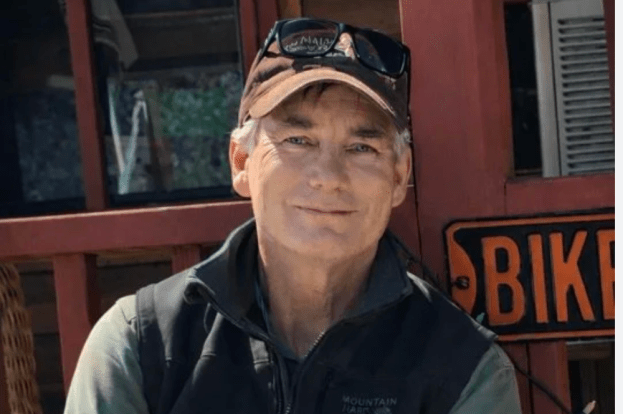
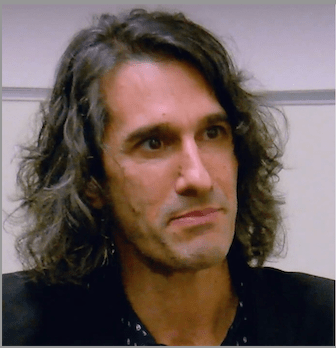
Dr. Charles G. Curtin is the director of Regenerative Conservation Design.
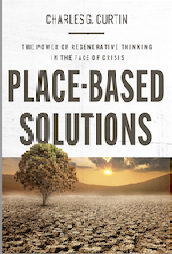
He is the author of The Science of Open Spaces: Theory and Practice for Conserving Large, Complex Systems and the coeditor of Complex Ecology: Foundational Perspectives on Dynamic Approaches to Ecology and Conservation. His latest book is PLACE-BASED SOLUTIONS: THE POWER OF REGENERATIVE THINKING IN THE FACE OF CRISIS, published by Johns Hopkins University Press. His books explore the intersection of ecology and culture and focus on how the word’s messiness leads to uncertainty and unexpected outcomes, and what to do about it.
Not merely a world renowned ecologist with conservation collaborations including cross-cultural conservation exchanges from the Middle East and Africa to the fisheries of Maine. His Two-Cowboys Project involves cross-continent learning networks between Maasai pastoralists in Kenya and US ranchers in the New Mexico/Arizona and Mexico borderlands, as well as Montana’s Blackfoot Challenge. The Crown of the Continent Partnership is a collaboration project on the borders of Montana, Alberta, British Columbia and the Salish and Kootnai Confederation. You can find out more about this ecosystem here: https://www.crownmanagers.org/about-the-crown
We spoke to him via Zoom from his home in Ranchos de Taos, NM on March 23, 2026.
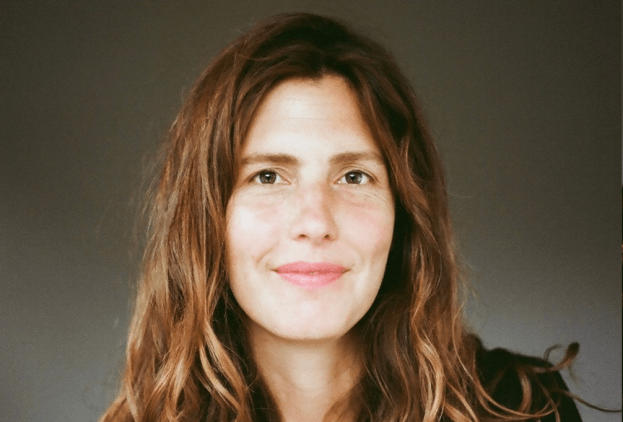
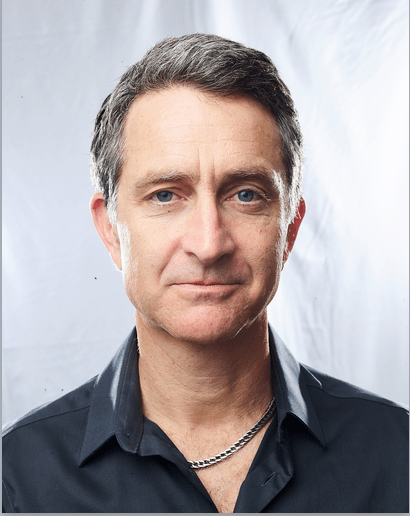
Dr. Christine Webb is an Assistant Professor in the Department of Environmental Studies at New York University, where she is part of the Animal Studies program. Her research is driven by growing awareness that the ecological crisis demands a profound shift in how we understand other animals and our place among them.
Her work seeks to elucidate the complex dynamics of animal social life, and to apply this knowledge to foundational questions in animal ethics and conservation. She investigates how animals manage and mitigate social disruptions, the emotional and motivational states that underlie those processes, and the cultural influences shaping them, with a focus on nonhuman primates.
She also studies how prevailing societal norms, values, and institutions shape contemporary scientific knowledge of other animals. As you will hear, her work examines the pervasiveness of the belief in human exceptionalism, and how this ideology—oftentimes hidden—biases scientific exploration of the more-than-human world.
She asks: How are cutting edge scientific insights revealing striking interdependencies among different species? How has anthropocentrism fueled an essentially competitive, hierarchical view of Nature? How does this in turn obscure our understanding of evolution, and of ourselves, in ways that perpetuate notions of human exceptionalism?How has this emphasis on competition led people to misinterpret and misuse evolutionary theory to explain the current anthropogenic crisis of life on earth? And How can a less anthropocentric understanding help us re-imagine it?
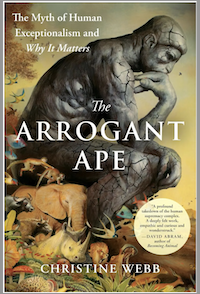
She explores these questions and more in her book, THE ARROGANT APE: THE MYTH OF HUMAN EXCEPTIONALISM AND WHY IT MATTERS, published by Avery. We spoke with Professor Webb on February 24, 2026 via Zoom as she, and many others were snowbound in New York.
This edition of Forthright Radio features Princeton University Anthropology Professor, Agustín Fuentes. His research focuses on the biocultural, delving into the entanglement of biological systems and the social and cultural lives of humans, our ancestors, and a few of the other animals with whom humanity shares close relations. Trained in both zoology and anthropology, his early work looked at the behavior and ecology of humans and other primates, and their patterns and trends in social organization. In the early 2000s, he added a focus on human biological variation, and the use – and misuse – of those patterns and processes in the context of race/racism and sex/gender.
Among his books, which we discuss in our interview with him, are his most recently published in 2025, SEX IS A SPECTRUM: THE BIOLOGICAL LIMITS OF THE BINARY; as well as his earlier, RACE, MONOGAMY, AND OTHER LIES THEY TOLD YOU; and THE CREATIVE SPARK: HOW IMAGINATION MADE HUMANS EXCEPTIONAL.
Illustration: Gender sexuality sex symbols – AnonMoos, Public domain, via Wikimedia Commons
An initial report of circa 241,000- to 335,000-year-old rock engravings and their relation to Homo naledi in the Rising Star cave system, South Africahttps://elifesciences.org/articles/89102
…Doug Wilson, the self-taught pastor who co-founded Pete Hegseth’s denomination has insisted that it was a mistake to let women vote. (He also teaches that sex “cannot be made into an egalitarian pleasuring party”, because “a man penetrates, conquers, colonizes, plants. A woman receives, surrenders, accepts.”)….
This edition of Forthright Radio is in two segments. In the first part, award-winning author, Lydia Reeder, discusses her latest book, THE CURE FOR WOMEN: DR. MARY PUTNAM JACOBI AND THE CHALLENGE TO VICTORIAN MEDICINE THAT CHANGED WOMEN’S LIVES FOREVER, published by St. Martin’s Press. It explores the pseudoscience that ties women’s health issues to their reproductive biology, and highlights the women doctors, scientists and suffragists, particularly Dr. Mary Putnam Jacobi, who fought back against these attempts to control women’s bodies and lives. At the end of her book, she quotes Ely Van De Warker, who wrote, “A woman’s ovaries belong to the Commonwealth; she is merely their custodian.”
We spoke with Lydia Reeder via Skype on March 7th, 2025.
Mary Putnam Kennedy
Then, in our second segment, we speak with Pagan Kennedy about her latest book, THE SECRET HISTORY OF THE RAPE KIT: A TRUE CRIME STORY. Our interview with Pagan begins at 25:50.
Lately I have been thinking a lot about ecologist and one time presidential candidate, Barry Commoner, and his Four Laws of Ecology, which he enumerated in his 1971 book, THE CLOSING CIRCLE. They are:
Everything is connected to everything else. There is only one Ecosphere for all living organisms, and what affects one affects all.
Everything must go somewhere. There is no “waste” in Nature, and there is no “away” to which things can be thrown.
Nature knows best. Humankind has fashioned technology to improve upon Nature, but such change in a natural system is likely to be detrimental to that system.
There is no such thing as a free lunch. Exploitation of Nature will inevitably involve the conversion of resources from useful to useless forms.
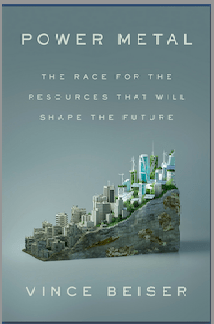
Our guest on this edition of Forthright Radio, award winning author and journalist, Vince Beiser, begins his latest book, POWER METAL: THE RACE FOR THE RESOURCES THAT WILL SHAPE THE FUTURE, with the statement, “There is no such thing as clean energy,” so I thought it would be good to find out more about his reporting from “over 100 countries, states, provinces, kingdoms, occupied territories, no man’s lands and disaster zones. He has exposed conditions in California’s harshest prisons, trained with US Army soldiers, ridden with the first responders to natural disasters, and hunted down other stories from around the world.”
His earlier book, The World in a Grain: The Story of Sand and How It Transformed Civilization, was a finalist for the PEN/E. O. Wilson Literary Science Writing Award. As well as A California Book Award. He has written for the Oakland Tribune, The LA Times, Village Voice, The Nation and Rolling Stone, as well as being the former senior editor of Mother Jones. We spoke with Vince Beiser from his home in Vancouver, British Columbia, via Skype.
POWER METAL: THE RACE FOR THE RESOURCES THAT WILL SHAPE THE FUTURE is published by Riverhead Books. Vince Beiser also writes on Substack, which you can access here: https://powermetal.substack.com
Due to time limitations, we were not able to discuss his chapter, “New Lives for Old Things,” on the Right to Repair movement. In it he writes about a couple of Cal Poly Tech students, who became so incensed at products designed to preclude owners from repairing them that they created a website iFixit, which hosts a free online repository of more than 103,000 do it yourself repair manuals for some 54,000 separate products. Here is a link: https://www.ifixit.com/
During the broadcast, I referred to the recent 5-2 Montana Supreme Court opinion, which upheld a permit the Montana Department of Natural Resources and Conservation issued to Tintina Montana Incorporated (now Sandfire Resources) to manipulate approximately 250 millions gallons of groundwater in pursuit of a 14 million-ton copper deposit in Meagher County, and which environmentalists fear will endanger the pristine Smith River. I misspoke, mentioning the transnational Rio Tinto mining company instead of Tintina Montana Incorporated.
On December 18, 2024 in a 6-1 ruling, The Montana Supreme Court upheld District Court Judge Kathy Seeley’s verdict in favor of the 16 Youth Plaintiffs in the Held v State of Montana case. They had sued the state for violations of their rights to a clean and healthful environment under the Montana State Constitution.
Melissa Hornbein Western Environmental Law Center
After the ruling, I invited Western Environmental Law Center attorney, Melissa Hornbein, a member of the plaintiffs’ legal team, and Anne Hedges of the Montana Environmental Information Center, whose lawsuits over the decades were cited by Chief Justice Mike McGrath’s opinion, and who had been an expert witness during the trail.
Anne Hedges Montana Environmental Information Center
Below are links to our coverage during the June 2023 trial, as well as other articles, etc. pertinent to the case and our interview.
Professor M. V. Ramana, a physicist by training, is Simons Chair in Disarmament, Global and Human Security and the director of the graduate program at the School of Public Policy and Global Affairs, University of British Columbia, Vancouver. He previously worked at the Nuclear Futures Laboratory and the Program on Science and Global Security, both at Princeton University. He is a member of the International Panel on Fissile Material, The International Nuclear Risk Assessment Group, and the team that produces the annual World Nuclear Industry Status Report. His earlier books are The Power of Promise: Examining Nuclear Energy in India, and Bombing Bombay? Effects of Nuclear Weapons and a Case Study of a Hypothetical Explosion.
Increasingly alarmed by more and more reports of well respected climate scientists, such as James Hansen, who promote nuclear energy as an important part of responding to rapidly increasing climate catastrophes, we spoke with Professor Ramana via Skype on November 4, 2024 about his latest book, NUCLEAR IS NOT THE SOLUTION: THE FOLLY OF ATOMIC POWER IN THE AGE OF CLIMATE CHANGE, published by Verso.
In this episode we share our interview with best selling author and Colorado Mesa University History Professor, Timothy Winegard. His latest book, THE HORSE: A GALLOPING HISTORY OF HUMANITY, is being published by Dutton on July 30, 2024. His five earlier books include THE MOSQUITO: A HUMAN HISTORY OF OUR DEADLIEST PREDATOR; THE FIRST WORLD OIL WAR; and FOR KING AND KANATA: CANADIAN INDIANS AND THE FIRST WORLD WAR.
We spoke with Professor Winegard about his fascinating book, THE HORSE: A GALLOPING HISTORY OF HUMANITY, on July 24, 2024, but a warning: the past two weeks since our most recent Forthright Radio had been characterized by technical breakdowns on several fronts. Without going into too many details, our Forthright Radio email address of many years became completely inaccessible on July 10th. Since July 12th, the computer had been elsewhere being worked on in the hope of retrieving the email information from it, but without success. Mere hours before our interview was scheduled,we got the computer back, but software we had been using for years, and which had been working when the computer was relinquished, no longer worked.
The reason we’re sharing this is because the audio software with which we record interviews was malfunctioning. We could hear and record Professor Winegard, but he couldn’t hear us, nor would the equipment record us. So, we had to do the interview recording him via Skype, and his listening to our questions via our ancient, failing land line phone. Bad as the audio quality of our questions is, Professor Winegard’s voice is of the quality you have come to expect. We are especially grateful to him for his patience and willingness to engage under such conditions.
The good news is that after our interview, the problems were located and remediated, so with any luck, this won’t happen again.
As for the Forthright Radio email address, that is sadly gone, never to return. However, we can still be contacted via the program’s website forthright.media contact page.
Zoë Schlanger is an award winning environmental journalist and reporter with The Atlantic. Her book, THE LIGHT EATERS: HOW THE UNSEEN WORLD OF PLANT INTELLIGENCE OFFERS A NEW UNDERSTANDING OF LIFE ON EARTH, was published in May 2024 by Harper.
We are at a revolutionary moment in the field of botany, a veritable paradigm shift for those who pay attention to such things, and Zoë Schlanger chronicles the remapping of scientific frontiers, as one assumption after another is being proven not only to be false, but ignorant and arrogant. Along with the scientists she interviews, she explores questions such as do plants communicate with each other and even other species? Can they recognize and favor their own kin? Can they respond to visual and aural stimuli, store memories and learn? Are they conscious and intelligent? How is any of this possible lacking a brain? We asked about these and other questions when we spoke with her via Skype on June 24, 2024.
This edition of Radio Goes to the Movies features two films that are screening at the Mendocino Film Festival, THE BIG SCARY ‘S’ WORD and FIRST WE BOMBED NEW MEXICO.
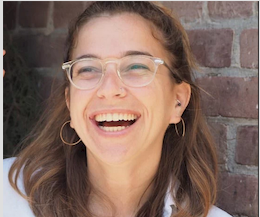
In our first segment, we spoke with Yael Bridge, who produced the award winning, Left on Purpose, and Saving Capitalism, starring former Secretary of Labor Robert Reich, which was nominated for an Emmy Award in Business and Economics. She was also the director of productions at Inequality Media, making viral videos that tackle complex political issues and gained over 100 million views in 2016. She lives in Oakland, where she works as a filmmaker and film educator. Her film, THE BIG SCARY ‘S’ WORD, which she directed and produced is screening on Sunday June 2nd, at the Matheson.
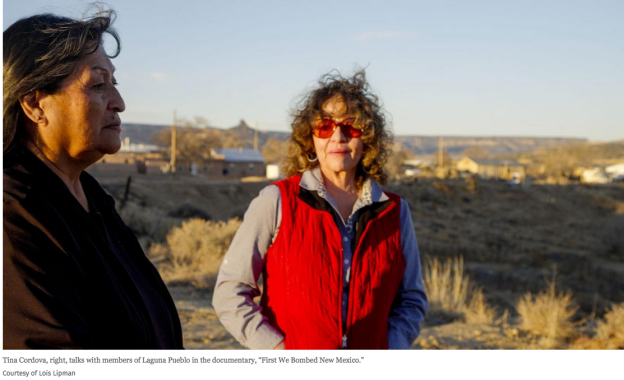
In our second segment, we spoke with Lois Lipman about her film, FIRST WE BOMBED NEW MEXICO, which tells the story that the blockbuster film, Oppenheimer, leaves out – about the nuclear victims of the first nuclear detonation in history, who lived in the villages around the Trinity test site. They were not warned, evacuated, nor informed after the explosion of any danger, much less protected from the fallout. The interview with Lois begins at 27:30.
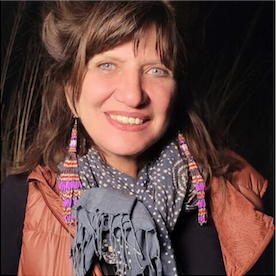
For many years Lois Lipman researched, developed, and field produced films for 60 Minutes worldwide —from India, Gaza, Guantanamo Bay to Paris and Saint Petersburg. Her films won numerous awards including an Emmy and a Peabody. Til Death Do Us Part: Dowry Deaths in India won Best Documentary of the Year from American Women in Television and Radio, and lead to the first arrests and convictions for this crime against women in India. After Lois left 60 Minutes, she worked internationally for the BBC, Channel 4 – UK, and PBS. After teaching at the University of Maryland, Lois returned to her home in New Mexico, where she committed to making FIRST WE BOMBED NEW MEXICO, a film that exposes the injustices suffered, and continuing to be suffered, for almost 8 decades by New Mexican Downwinders. It screens on Sunday, June 2, at 10:30a.m. at The Coast Cinemas.
Special thanks to Paul Pino for permission to include his anthem, “It Ain’t Over Til We Win,” from FIRST WE BOMBED NEW MEXICO.








 Forthright Radio