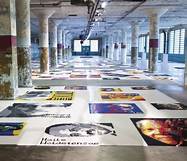
Following his detention by Chinese authorities, outspoken artist/activist Ai Weiwei transformed the former island penitentiary of Alcatraz into an artistic platform. The exhibition engaged 900,000 visitors about the plight of prisoners of conscience around the world.
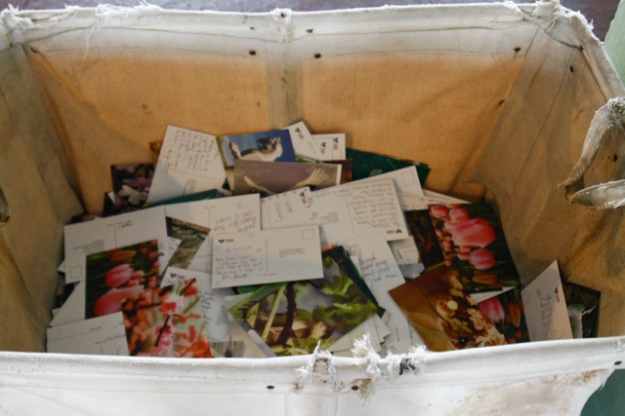
Yours Truly, a piece in the exhibit, invited visitors to compose messages of hope on postcards to prisoners incarcerated or exiled due to their beliefs, affiliations, and nonviolent expressions of dissent. The film follows these postcards around the globe as director Cheryl Haines meets with former prisoners of conscience and their families to discuss their impossible choices and the comfort they found in messages sent by people they would never meet. The film explores Ai Weiwei’s inspiration for the project. Interviews with the artist, his mother, and lifelong friends uncover the touching story of a childhood spent in exile. Ultimately, the film is a call to action, extending the reach of Ai Weiwei’s art by asking viewers to take to heart the issue of global human rights. In Mandarin and English with English subtitles.
More than 50,000 postcards were written by visitors and sent to prisoners of conscience, displaying the national flower or bird of their country.
After 10 years of research, Adam Higginbotham’s book, MIDNIGHT IN CHERNOBYL: The Untold Story of the World’s Greatest Nuclear Disaster,provides the first complete account of the catastrophe that encircled the world and helped precipitate the fall of the USSR. It is published by Simon & Schuster.
Some articles referring to the event can be found here:
Since the explosion at the Chernobyl nuclear power plant in 1986, an area of more than 4,000 square kilometres has been abandoned. That could be about to change, as Victoria Gill discovered during a week-long trip to the exclusion zone.
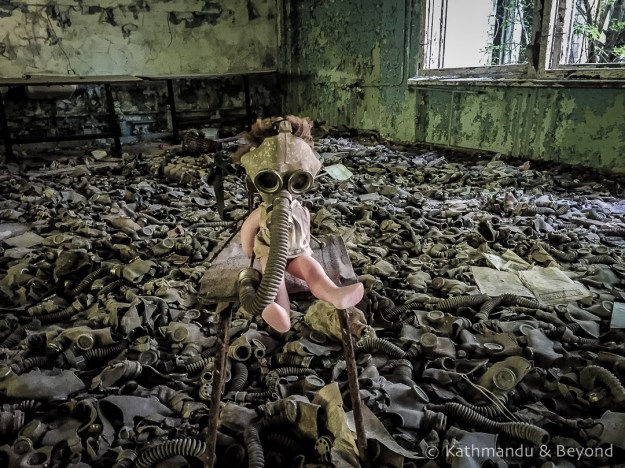
On April 26, 1986, technicians conducting a test inadvertently caused the fourth reactor to explode. Several hundred staff members and firefighters then tackled a blaze that burned for 10 days and sent a plume of radiation around the world in the worst-ever civil nuclear disaster. More than 50 reactor and emergency workers were killed at the time. Authorities evacuated 120,000 people from the area, including 43,000 from the city of Pripyat. Below, recent images from Chernobyl and nearby ghost towns within the exclusion zone, as well as memorials held in Ukraine and Russia.
David Treuer is Ojibwe from the Leech Lake Reservation in northern Minnesota. The author of four previous novels, most recently Prudence, and two books of nonfiction, he has also written for The New York Times, Los Angeles Times, Esquire, Slate, and The Washington Post, among others. He has a Ph.D. in anthropology and teaches literature and creative writing at the University of Southern California.
David Treuer’s latest book, THE HEARTBEAT OF WOUNDED KNEE: NATIVE AMERICA FROM 1890 TO THE PRESENT, is published by Riverhead Books.
Here is an edited extract from The Heartbeat at Wounded Knee: Native America from 1890 to the Present, referenced in this interview, which was published in The Guardian.
Julian Brave NoiseCat is an enrolled member of the Canim Lake Band Tsq’escen in British Columbia. He is a graduate of Columbia University, and received a Clarendon Scholarship to study global and imperial history at the University of Oxford. He was formerly the native issues fellow at The Huffington Post. He writes for The Guardian, The Nation, The Paris Review, CBC, Vice, Pacific Standard, Dissent, Jacobin, Fusion, Indian Country Today, Salon, High Country News, Canadian Geographic, Frontier Magazine, World Policy Journal as well as other publications.
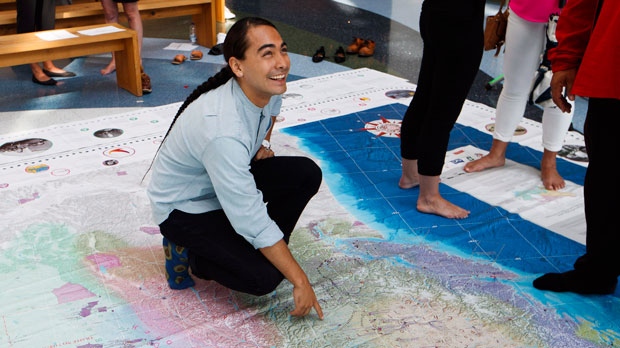
Julian Brave NoiseCat, a contributing editor of the newly unveiled Indigenous Peoples Atlas of Canada, points on a giant map at a launch event in Toronto, Wednesday August 29, 2018. The Indigenous Peoples Atlas of Canada includes a four volume print atlas, an online atlas, an app, and a giant floor map. (THE CANADIAN PRESS/Mark Blinch)
We first had Dahr Jamail on Forthright Radio in March, 2005 with Mark Manning, to discuss what was going on with the U.S.’s Second Siege of Fallujah, Iraq. He courageously went there un-embedded and defied the military information blockade to report what had actually happened there. Since then he has been our guest five times over the years.
For the past few years, he has been focusing on Climate Disruption in various journals, including truthout.org, where he had been publishing monthly Climate Dispatches.
And now his book, THE END OF ICE: BEARING WITNESS AND FINDING MEANING IN THE PATH OF CLIMATE DISRUPTION has been published by The New Press. He goes to many places around the world and speaks with indigenous people and scientists on the front lines of what can only be described as an accelerating global disaster of human caused climate disruption, geological change and mass extinction. Unlike most other narratives of climate disruption, not only does he document the science, but he also addresses the emotional, psychological, philosophical and ethical dimensions.
I was struck by a simple observation he makes between the outlook of dominant settler colonialist cultures, which speak of rights, and of most indigenous cultures, which emphasize obligations. That lead to what one of your interviewees called “the con job of hope and hopelessness,” and what you say is “the necessity of unblocking grief.”
“It is not light that is needed, but fire; it is not the gentle shower, but thunder. We need the storm, the whirlwind, the earthquake. The feeling of the nation must be quickened; the conscience of the nation must be roused; the propriety of the nation must be startled; the hypocrisy of the nation must be exposed; and the crimes against God and man must be proclaimed and denounced.” from A Democracy in Exile Fights Against Fascism
In this edition of Forthright Radio, we welcome back Professor Henry Giroux, who holds the McMaster University’s Chair for Scholarship in the Public Interest in the English and Cultural Studies Department, and who is the Paulo Freire Distinguished Scholar in Critical Pedagogy. He is a prolific author and journalist. His books -more than 65 – include AMERICA AT WAR WITH ITSELF; DISPOSABLE FUTURES: VIOLENCE IN THE AGE OF SPECTACLE; HEARTS OF DARKNESS: TORTURING CHILDREN IN THE WAR ON TERROR; ZOMBIE POLITICS AND CULTURE IN THE AGE OF CASINO CAPITALISM, and THE VIOLENCE OF ORGANIZED FORGETTING.
Articles by Professor Giroux cited in this interview include:
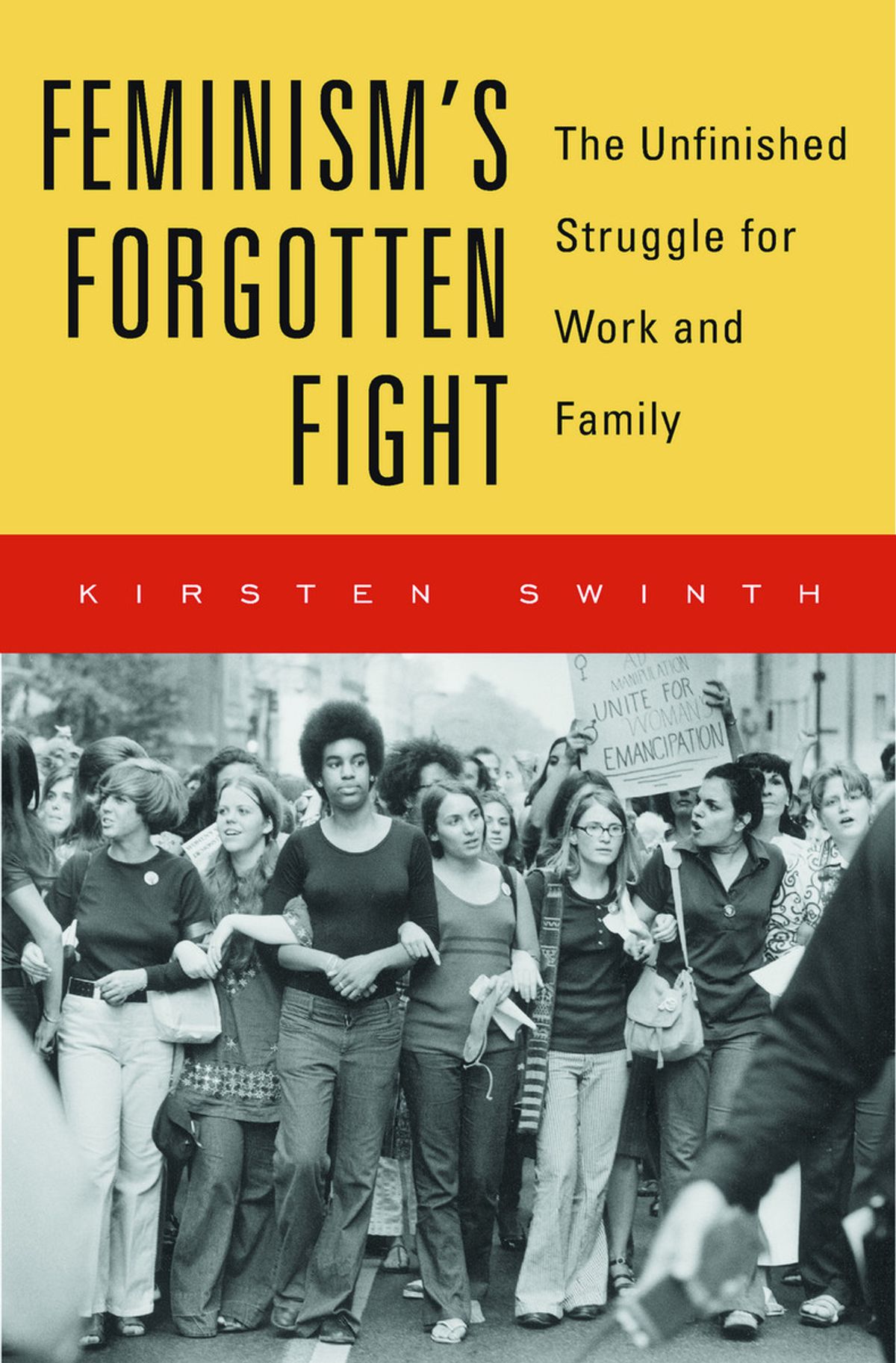
In her latest book, FEMINISM’S FORGOTTEN FIGHT: THE UNFINISHED STRUGGLE FOR WORK AND FAMILY, Fordham University Associate Professor of History, Kirsten Swinth, corrects many myths and misconceptions about Second Wave Feminism, demonstrating that it isn’t feminism that has betrayed women, but the society that failed to make the far-reaching changes for which feminists fought in the period 1963 to 1978.
Given the unauthorized release of Justice Samuel Alito’s draft opinion in Dobbs v. Jackson Women’s Health Center on May 2, 2022, we revisited this interview from October, 2018. Rebecca Traister joined us again to update us on the evolving situation, which can be heard at the end of the archived interview.
Rebecca Traister is writer at large for New York magazine, whose latest book is GOOD AND MAD: THE REVOLUTIONARY POWER OF WOMEN’S ANGER, published by Simon & Schuster. . Her earlier books include ALL THE SINGLE LADIES, and the award winning BIG GIRLS DON’T CRY. Her work has been published in The Nation, The New York Times, The Washington Post and the New York Observer among other publications.
This was the very first edition of what would become Forthright Radio. It was originally broadcast in November, 2004. We spoke with John M. Barry, author of the book, THE GREAT INFLUENZA: THE EPIC STORY OF THE DEADLIEST PLAGUE IN HISTORY. 100 years ago, in 1918, as a war weary world sought to bring those years of horror we call World War I to an end, another horror arose – a new, virulent and highly contagious strain of influenza, which within, a year spread rapidly around the world. We’ll never know the exact number of those killed, but it is estimated that a minimum of 50 million, and as many as 100 million died. At today’s population level, that would be between 150 million and 300 million dead worldwide. As we begin the annual flu season, our guest, John M. Barry, tells us what we know about this pandemic and warns of the possibility of such a global pandemic occurring again in our own time. But this is not just a history of a medical disease, his depiction of the politics of the war-time situation has disturbing foreshadowing of some of the same polarized dynamics with which we find ourselves grappling today, where truth is dismissed as an arbitrary term and “the force of an idea lies in it’s inspirational value. It matters very little whether it is true or false.” As Mark Twain put it so well, History doesn’t repeat itself, but it often rhymes. Although this interview was conducted in 2004, when George W. Bush was president, and we were 9 months into our invasion of Iraq, and the parallels to the Wilson administration are noted, some of those parallels seem even more pertinent today under the current administration.
Dean Baker co-founded The Center for Economic and Policy Research in 1999. His areas of expertise include housing and macroeconomics, intellectual property, Social Security, Medicare and European labor markets. Before that, he worked as a senior economist at the Economic Policy Institute, and was an assistant professor at Bucknell University. He has also worked as a consultant for the World Bank, the Joint Economic Committee of the U.S. Congress, and the OECD’s Trade Union Advisory Council. He is frequently cited in economics reporting in major media outlets, including the New York Times, Washington Post, CNN, CNBC, and NPR. He writes a weekly column for the Guardian Unlimited (UK), the Huffington Post, TruthOut, and his blog, Beat the Press, features commentary on economic reporting.
He is the author of several books, includingRigged: How Globalization and the Rules of the Modern Economy Were Structured to Make the Rich Richer; Getting Back to Full Employment: A Better Bargain for Working People; The End of Loser Liberalism: Making Markets Progressive; and The Conservative Nanny State: How the Wealthy Use the Government to Stay Rich and Get Richer. He was last our guest on Nov. 15, 2017.
Publications mentioned in this edition of Forthright Radio include:















 It is published by Harvard University Press.


 Forthright Radio